Alumni Newsletter
April 2026
February 2026
December 2025
Community Newsletter
Across research, competition, classroom conversation, and hands-on product development, this spring's stories reflect how Lally students and faculty are engaging with the technologies and ideas shaping what comes next.

Dean's Message
At Lally, we believe the future belongs to people who can think across disciplines, adapt quickly, and turn ideas into action. This issue highlights exactly that spirit. From student success at major hackathons, to faculty research exploring how AI is reshaping invention, to hands-on programs like the Lally AI Academy, our community is not simply reacting to change. We are helping shape it.
What stands out most is the combination of curiosity, rigor, and practical experimentation. Our students and faculty are engaging emerging technologies in ways that are thoughtful, ambitious, and grounded in real-world impact. That work reflects Lally's commitment to developing leaders who build what comes next.
Student Spotlight: Learning to Build, Pivot, and Win
Lally student Tazeem Mahashin earns recognition at two major hackathons with projects spanning AI, blockchain, and real-world problem solving
Some of the most consequential skills students develop resist easy measurement. They surface under conditions that demand adaptability, sound judgment, and the capacity to move forward when initial assumptions prove inadequate.
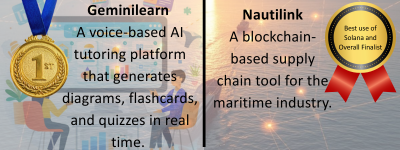
Those qualities are evident in the recent achievements of Tazeem Mahashin '28, a dual major in Information Technology and Web Science and Finance, who earned recognition at two competitive hackathons with substantively different projects. At Columbia Business School's Google Hackathon, Tazeem and teammate Vera Malkova took first place with Geminilearn, a voice-based AI tutoring platform designed to respond in real time and generate diagrams, flashcards, and quizzes dynamically. At HackPrinceton, he joined a team developing Nautilink, a blockchain-based supply chain tool for the maritime industry, which received Best Use of Solana recognition and an Overall Finalist designation.
What distinguishes the two experiences is not technical breadth alone, but the ability to exercise judgment under constraint. At HackPrinceton, Tazeem made a late-stage decision to join a different team mid-competition after being recruited on the basis of his portfolio. The group undertook an ambitious integration of computer vision, IoT sensors, NFC scanning, blockchain infrastructure, and a mobile application within a 36-hour window. Not every component reached full functionality by the time of the demonstration, but the conceptual foundation remained sound, the team delivered a coherent product, and the project earned meaningful recognition from judges.
A comparable willingness to reassess shaped the outcome at Columbia. Tazeem and Vera Malkova initially pursued a different concept before determining it was not adequately addressing a genuine need. They redirected their effort toward a more responsive and conversational learning tool for students navigating demanding academic environments. The result was Geminilearn. Their first-place finish carried awards of $15,000 in Google Cloud credits, tickets to Google I/O 2026, and a private pitch session with Google's AI Futures Fund.
Tazeem attributes part of his preparation to his experience at RPI, particularly through programs such as Rensselaer Center for Open Source, which reinforced a principle central to applied innovation. Technical proficiency matters, but so does the capacity to recognize when to persist, when to simplify, and when to change course. Those are the decisions that shape viable products, and they are the kinds of lessons students carry well beyond the duration of any single competition.
His hackathon results illustrate the kind of learning that emerges when students are positioned to work across disciplines, take considered risks, and test ideas against real constraints. At Lally, the convergence of business, technology, and applied problem solving continues to provide students like Tazeem with the foundation to build with confidence and perform at a competitive level. Read More.
Faculty Research: How AI Is Opening New Frontiers in Innovation
New research from Lally's Shyam Kumar and Xinying Qu '24 examines how artificial intelligence is transforming the very nature of invention
Artificial intelligence is frequently characterized as a tool that accelerates search, improves efficiency, or enhances information processing. New research from Shyam Kumar of the Lally School of Management and Xinying Qu '24 suggests its influence on innovation extends considerably further.
In a forthcoming paper in the Strategic Management Journal, titled "Unlocking novel knowledge recombinations: The effect of artificial intelligence on inventive activity," Kumar examines how AI is reshaping the structure of the innovation process itself. Drawing on U.S. firm patenting data from 2005 through 2023, the study finds that inventions incorporating AI are associated with a greater degree of novel knowledge recombination than those that do not.
The research challenges a narrow reading of AI's role in inventive activity. Rather than functioning solely as a mechanism for faster search or more efficient identification of promising options, AI appears to operate as a connective layer across knowledge domains, facilitating combinations between fields that may previously have had little interaction. This capacity expands the frontier of what recombination is feasible, enabling inventions that might not have emerged through conventional approaches.
These findings carry broader significance for the study of innovation. Scholars have long recognized that inventive activity depends on the novel combination of existing ideas, methods, and technologies. Kumar's work suggests that AI is not merely augmenting that process but altering its underlying logic.
For organizations and management researchers alike, the implications are substantial. As AI becomes more deeply embedded in how firms create, compete, and adapt, understanding its structural role in inventive activity becomes a pressing concern for both theory and practice. The paper contributes to a growing body of scholarship that positions AI not only as a productivity-enhancing technology, but as an enabler capable of bridging previously siloed knowledge domains and reshaping the conditions under which new ideas emerge.
The study also reflects a broader research orientation at Lally. As the relationship between business and technology grows increasingly complex, faculty scholarship is advancing rigorous inquiry into the opportunities and challenges that accompany that shift. Kumar's work represents one contribution to ongoing scholarly conversations about innovation, competitive strategy, and the evolving dynamics of the knowledge economy. Read More.

AI Academy Opens the Door to Hands-On Experimentation
Lally's AI Academy gives students a chance to build, test, and launch ideas in a fast-moving 30-day sprint
As conversations about artificial intelligence continue to expand across higher education and industry, one question remains especially important for students: how do you move from learning about AI to actually working with it?
At the Lally School of Management, the AI Academy is designed to help answer that question. Beginning April 1, the program's 30-day sprint invites students to work in teams to design, build, and launch AI-powered products, giving them direct experience with the tools, decisions, and problem-solving that shape real-world innovation.
What makes the program especially compelling is its accessibility. The sprint is open to students from across majors, and no coding background is required. Instead, the focus is on collaboration, experimentation, and learning by doing. Students are encouraged to think broadly about how AI can be applied, manage a budget, work through constraints, and move an idea toward something tangible and usable.
That structure reflects a larger shift in business and technology education. Increasingly, students benefit not only from understanding emerging tools in theory, but from learning how to ask better questions with them, test ideas quickly, and make thoughtful decisions in the process. The AI Academy creates space for that kind of learning by bringing together students with different strengths and asking them to build something real in a short period of time.
The sprint also highlights an important part of the Lally approach. Innovation is not treated as something abstract or distant. It becomes a practice. By giving students the opportunity to move from concept to execution, the AI Academy helps them build confidence, develop fluency with emerging technologies, and better understand how business, creativity, and technical possibility come together.
As this year's sprint gets underway, the AI Academy adds another dimension to the work already happening across Lally, where students are exploring new technologies not just as observers, but as active participants in shaping what comes next. Read More.