 Edgar Ancona didn't arrive at Rensselaer Polytechnic Institute with a clear plan. Like a lot of RPI students, he started in engineering. His father was an engineer, and it seemed like a reasonable career path. One semester in, he knew it wasn't for him.
"I really had no idea, from a job point of view, what I wanted to do," he recalled. That honest uncertainty, it turns out, became one of the defining threads of his career. Ancona went on to hold senior roles at Citi, Household, and HSBC, but his path wasn't the story of someone who had it mapped out from the start. It was the story of someone who learned to recognize fit, lean on the right people, and keep adapting long after graduation.
Finding His Footing at Lally
Ancona describes landing at the Lally School of Management as something he "backed into," but it turned out to be the right move. He wanted to stay at RPI, and Lally gave him a way to combine analytical thinking with bigger questions about business and careers.
The most influential person during that stretch was Professor Barry Jack. Ancona wasn't particularly drawn to marketing, but Jack's classes stuck with him. More than the content, though, it was how Jack pushed students to think about themselves.
"He was really good at pointing those things out," Ancona said. "Think about yourself and here are the things you've got to leverage that somebody else might not."
For Ancona, that meant leaning into an international perspective he'd developed through family connections abroad and travel in Europe. Jack also encouraged him to apply to the University of Chicago for graduate school, a nudge that shaped everything that followed. Looking back, Ancona sees that kind of mentorship less as guidance and more as someone helping him ask better questions about where he could thrive.
What RPI Really Teaches
Beyond mentorship, RPI's academic culture gave Ancona something harder to name but just as lasting: the confidence to tackle unfamiliar problems without flinching.
The workload was demanding, and early on it could feel overwhelming. But over time, working through that rigor builds something real. "When you see a problem, how do you think about it logically, not get intimidated by it, break it up into the right pieces in a way that you can deal with it?" he said. He found parts of graduate school manageable precisely because RPI had already put him through the paces.
The takeaway wasn't any particular skill or formula. It was the habit of staying composed when you don't immediately know the answer. "The one thing you really took away that mattered in life was that ability to think about a problem that you haven't seen before and how you're going to deal with it."
Leadership Is a People Problem
Ancona's real education in leadership started at Citi. He came in as an analyst, and within a few years found himself running a team. That shift changed his understanding of what the job actually was.
He wasn't just responsible for his own output anymore. The work, confidence, and careers of other people were tied to how he led. "You're only going to succeed if they do," he said. "So you need to make them successful." The first hard lesson: being in charge doesn't mean being right. "You're not always right." That realization anchored everything else, namely that leadership isn't about issuing direction, it's about helping people do their best work together.
Calm Under Pressure
One of the starkest tests came in 2002, when Ancona was treasurer at Household during a period of serious turbulence in the commercial paper markets. Investors got nervous. Employees didn't know what was coming. Inside the organization, the mood was anxious.
His job was to keep the team grounded. Part of it was preparation, as the company had already thought through difficult scenarios before they arrived. But the other part was more human. "We've been preparing for this day," he told people, even when they hadn't realized it. Helping them trust what they'd already built mattered just as much as any tactical response. "Providing calm, having thought things through, but then also just getting people to trust themselves. That everything would be fine." And it was.
The Mentors Who Made a Difference
Throughout his career, Ancona kept returning to mentors at key moments. At RPI, Professor Jack gave him direction and a path to graduate school. At Citi, Don Howard, CFO, guided his development and eventually connected him to the Household opportunity through a direct reference to the company's top leadership. Later, Bobby Mehta at HSBC America was someone whose counsel Ancona consistently valued.
The pattern was consistent: mentors mattered most at inflection points. "You want to talk to somebody whose opinion you respect," he said simply.
Today he plays that role for others, particularly former colleagues navigating senior transitions. He's also come to see that the right mentor depends on where someone is in their career. A student hunting for a first job needs something different from a mid-level executive weighing a strategic move. And younger alumni, he points out, can be especially valuable to students because they understand today's job market in ways a senior executive simply might not.
Staying Connected to Lally
Ancona remains involved with Lally because he believes the school gave him something real, not just a degree, but direction at a moment when he had none. "It's easy to say give back," he said, "but part of that give back is you feel like you owe something too."
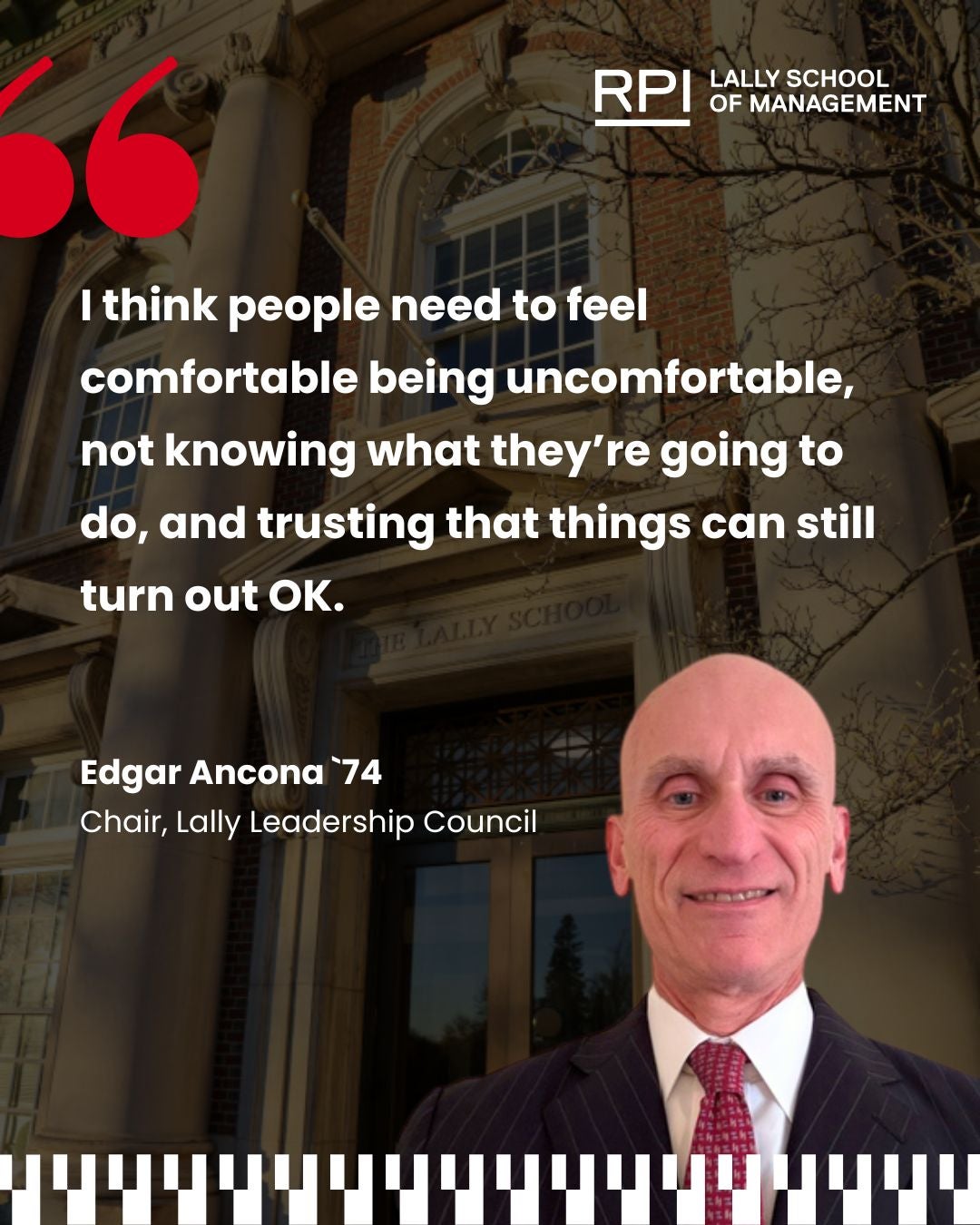
The message he most wants current students to hear is a simple one: not knowing what you want to do isn't a problem to be solved before you can start. "I think people need to feel comfortable that they're uncomfortable, don't know what they're going to do, and that it could still turn out OK." He's proof of it.
He also believes that whatever path students pursue, genuine interest isn't optional. "If you don't find it interesting, it doesn't matter what it is, you're not going to do well."
Still Learning
After a long career, Ancona recently started advising for a consulting firm that, since he joined, has pivoted sharply toward artificial intelligence. "I know nothing about AI," he said with a laugh, "so it's been a fantastic education."
That willingness to step into unfamiliar territory may be the clearest constant across his career, from switching into Lally, to Chicago, to decades in financial services, to advising in a field being remade in real time. "You get stale if you don't keep trying to learn stuff."
For students at Lally, his story offers a straightforward reassurance: a career doesn't require a perfect plan at the start. It requires learning how to think through hard problems, how to lead people well, and how to stay curious about what comes next.
Author: Lynda Holt, holtl3@rpi.edu