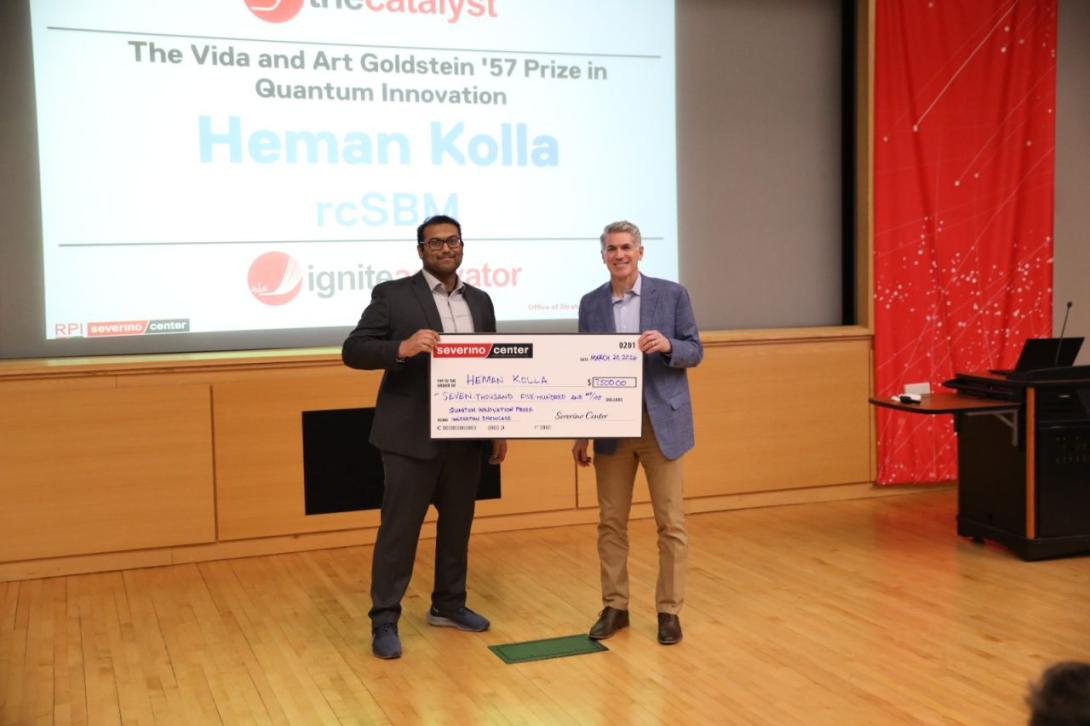
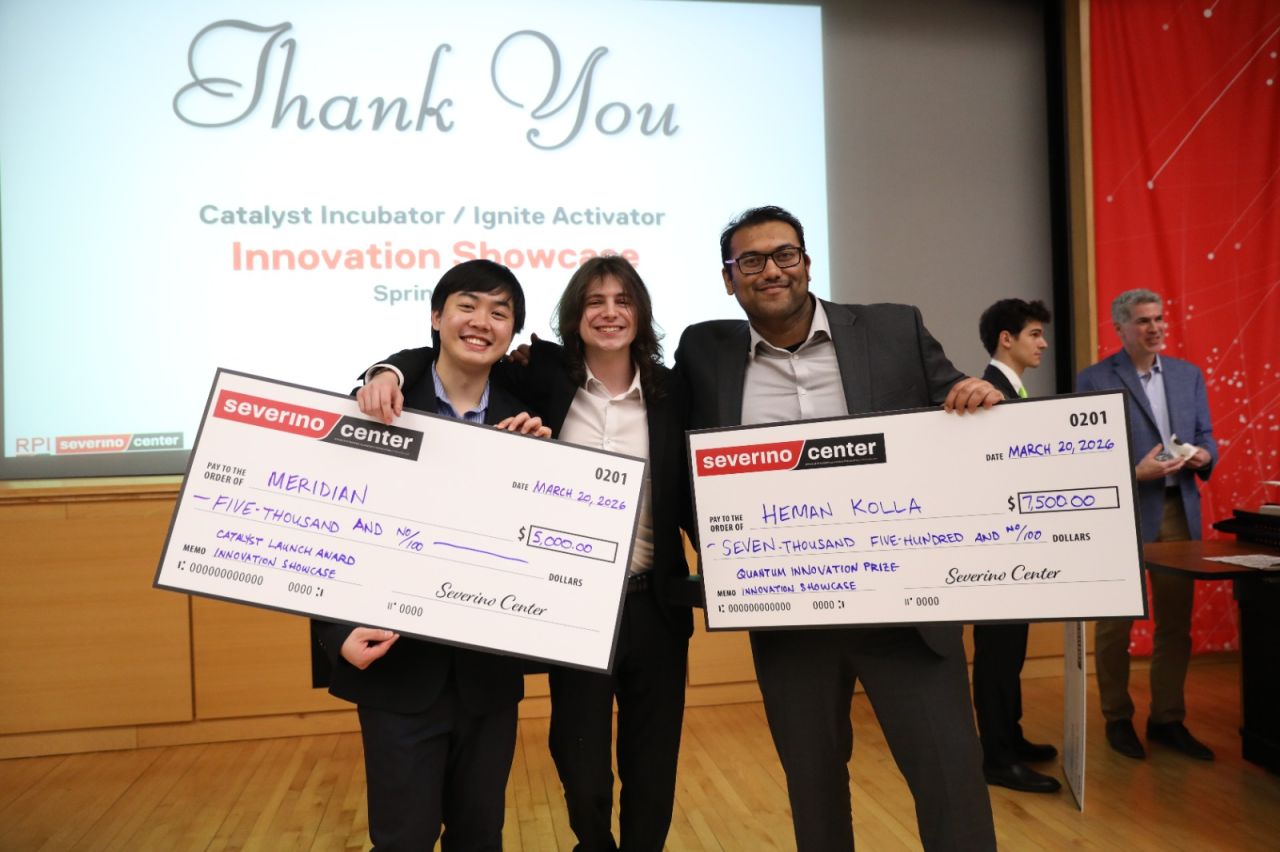
As a senior in RPI's Information Technology and Web Science (ITWS) program, Heman is piloting the university's quantum computing track, and already making waves well beyond the classroom. At the Severino Center for Technological Entrepreneurship's Innovation Showcase, he was awarded the Vida and Art Goldstein '57 Prize in Quantum Innovation, which recognizes high-potential student innovations in quantum science and encourages translating them into real-world impact. He then followed that up by winning first place in the software track at the New York Business Plan Competition's Capital District regional, all while preparing to begin his co-terminal master's degree in the fall.
His winning work is the replica-coupled Simulated Bifurcation Machine (rcSBM), a novel quantum-inspired optimization framework he provisionally patented last fall. It’s a problem solver. Feed it an optimization challenge, bus routes, warehouse logistics, production schedules, financial portfolio balancing, and it finds the best configuration from a set of options. What makes the rcSBM different is that it delivers both speed and accuracy, eliminating a trade-off the field had long accepted as unavoidable.
"There are two different quantum computing models people have been using," Heman explained. "One is the most accurate solver, the other is the fastest. I combined the strengths of both into a new formulation that gives you faster results and more accuracy without having to face that trade-off everyone else has to make."
The technical challenge was formidable. The two underlying models, quantum annealing and Duffing oscillation, draw on entirely different physics concepts. In theory, no one had put them together until Heman did.
"Trying to figure out where you can hybridize or find the strengths of different works and bring them together is a real challenge," he said. "That's where I picked my focus."
Why RPI 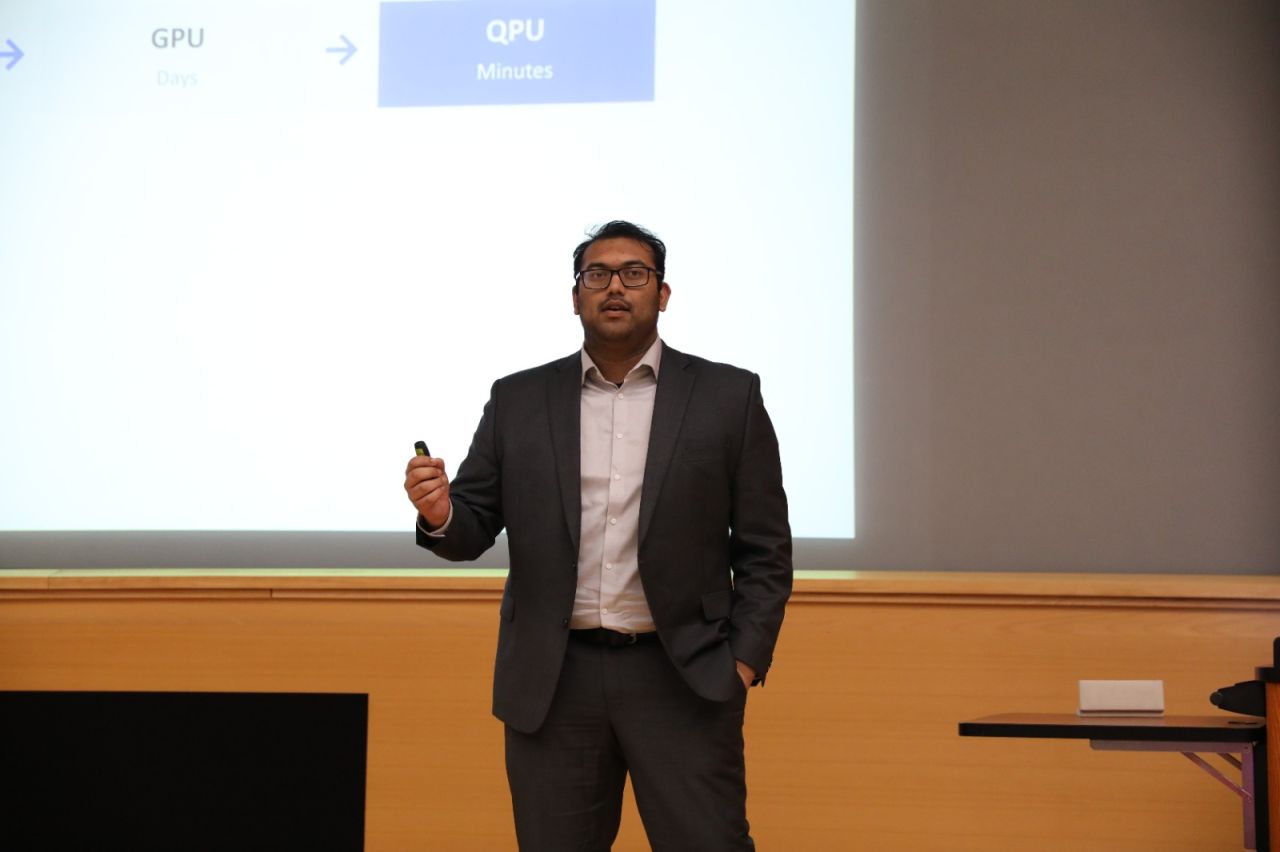
Heman's decision to attend RPI was driven in part by the university's announcement that it would house the world's first IBM Quantum System One on a university campus. But even beyond the quantum computer, RPI's computing resources stood out.
"RPI has some of the best resources for computer science and IT students in the world," he said. "We're the only private university with a quantum computer, and our AiMOS supercomputer is the fastest on any private university campus in the United States. We literally have the best of both worlds."
That infrastructure isn't just a talking point. Heman uses terminology in his pitches that he says he could only use because of RPI's unique combination of GPU systems, quantum processing units, and traditional CPUs. These resources give students a real edge in high-performance computing.
Shaped by the ITWS Program
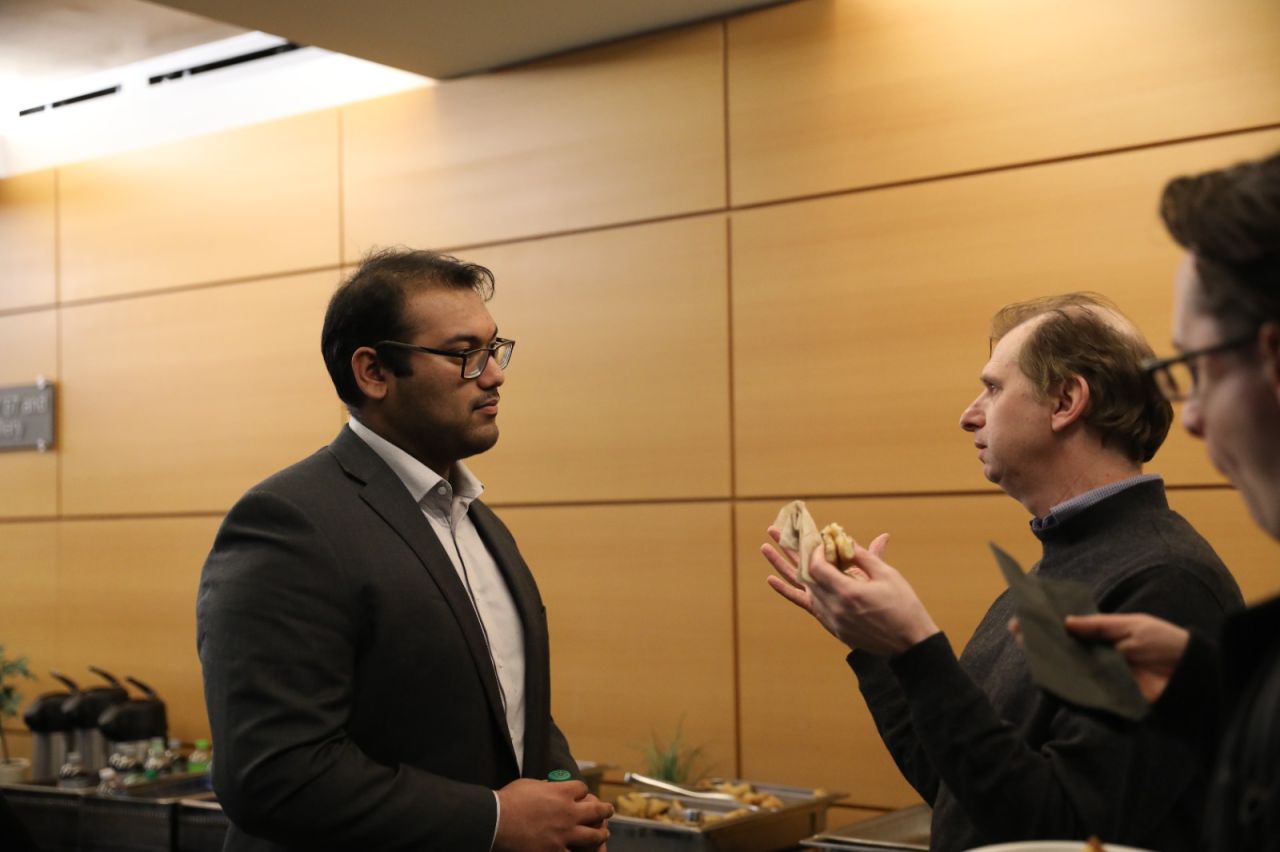 Heman credits RPI's ITWS program with shaping how he thinks, not just what he knows. While computer science gave him theoretical tools for computational verification, ITWS taught him to think at the systems level, designing entire architectures from the ground up and justifying every design choice.
"In ITWS, we're not told to work with one technology and go with it," he said. "We're expected to design the entire system, then justify the design choices that best exemplify whatever solution we proposed. That's exactly what I did with this framework."
Upper-division courses like MITRE and Capstone reinforced that client-centered, problem-solving mindset, skills that translated directly into how Heman approached developing and pitching a real invention.
A Community That Shows Up
The rcSBM didn't come together in isolation. Heman provisionally patented his framework last fall with significant guidance from the Severino Center. Dr. Eric Ledet and Dr. Randy Stewart served as key advisors, helping him navigate the legal landscape and prepare for his first-ever pitch at the Innovation Showcase. 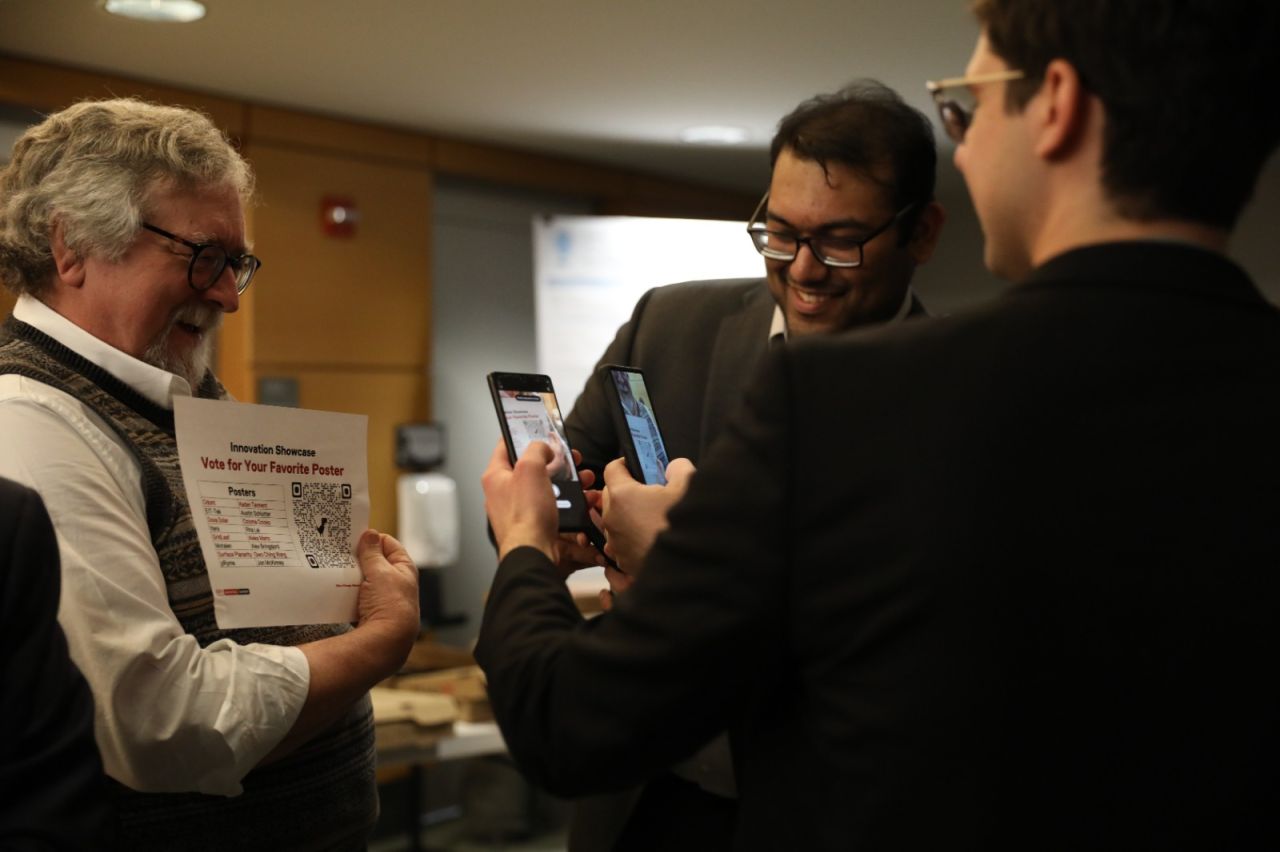
But the support went further than formal mentorship. When Heman needed to sharpen his presentation, he turned to the people around him, CS and ITWS advisors who gave him ten minutes to practice, a professor who let him pitch to an entire class after it let out early, and fellow students in the ITWS Lounge who helped him refine his delivery.
"Everyone let me pitch them," he said. "They were very helpful in letting me practice."
That kind of accessibility is something Heman sees across the RPI entrepreneurial community, particularly through the Flying Pig Society, a student organization affiliated with the Severino Center where he serves on the executive board.
"If you've been in the incubator program or the Flying Pigs community, you know each other," he said. "Everyone knows what resources are there because there's really one place to go for it, the Severino Center, and the Flying Pigs is the perfect connector for students to get engaged."
The results speak for themselves. At the recent NYBPC Capital District regional, nine RPI teams pitched out of roughly forty entrants. Six of the ten teams that advanced were from RPI—all members of that same entrepreneurial community.
What's Next
Heman is now deep in the startup phase, validating his technology and building out a business plan. He has a provisional patent, the Goldstein Prize, a first-place regional win, and a growing advisory team. The state finals of the New York Business Plan Competition are next on the horizon.
His advice to other RPI students with big ideas? Get involved with the Flying Pig Society and the Severino Center, and don't wait until you feel ready.
"The second I kept getting traction, it kind of pulled me into the world on its own," he said.
Author: Kyle Roth, rothk2@rpi.edu